Olympusdao treasury: Assessing OHM Backing
The Olympus treasury holds the assets that the Olympus protocol owns and controls, including reserves and OHM liquidity positions. Assessing its backing means distinguishing those holdings from OHM’s trading price, the income available for buybacks and deposits held separately for users.
Treasury Value and Liquid Backing
Total treasury value is an aggregate asset valuation. Liquid backing per OHM is a per-token measure, while OHM’s market price is the price available through trading. These figures answer different questions. A treasury total alone does not establish how much backing supports each OHM or the price at which a particular sale could execute.
OHM has a floating price and no fiat peg. Treasury backing therefore does not promise a fixed dollar sale price. Comparisons of backing across dates need consistent asset valuations and supply definitions; a larger reserve balance alone does not establish that backing per OHM increased.
Reserves, Liquidity and Credit
Protocol-owned liquidity puts treasury assets into trading markets. Olympus documents an OHM/wETH Uniswap V3 position that is intended to provide lasting liquidity, subject to governance changes. Its purpose differs from holding reserves outside a pool: liquidity positions support exchange, while reserves fund the protocol’s other financial operations. Protocol ownership does not make the execution price of every trade identical to reported backing.
Cooler V2 provides a separate use of treasury USDS: lending against gOHM collateral on Ethereum. Borrowing creates a debt obligation. V2 has no liquidation triggered by OHM’s market price, although unpaid interest can push debt per unit of gOHM collateral above the configured liquidation threshold. Access to backing through this facility remains subject to its collateral and borrowing limits.
Asset names also depend on the facility and version. Legacy Cooler V1 used DAI and held idle lending capital in sDAI. Cooler V2 lends USDS. The Yield Repurchase Facility draws its allocated savings yield in sUSDS. These descriptions identify particular flows; they do not establish the proportions of every asset in the treasury.
Yield and Repurchase Funding
The Yield Repurchase Facility (YRF) uses protocol earnings for OHM purchases. Its weekly accounting includes yield from USDS savings reserves and interest from Cooler Loans, with previously recorded earnings supplying a later weekly allocation. Daily purchase markets combine part of that allocation with backing obtained from OHM bought earlier. The facility obtains USDS against those purchased tokens at a configured backing value and burns the OHM.
Repurchase capacity is an offered budget; completed purchases depend on market fills. The documented YRF mechanism allows for incomplete execution during rapid price declines. Reusing backing can increase cumulative purchase spending beyond the original yield allocation without creating an equivalent amount of new earnings.
Worked Example: Earnings and Reused Backing
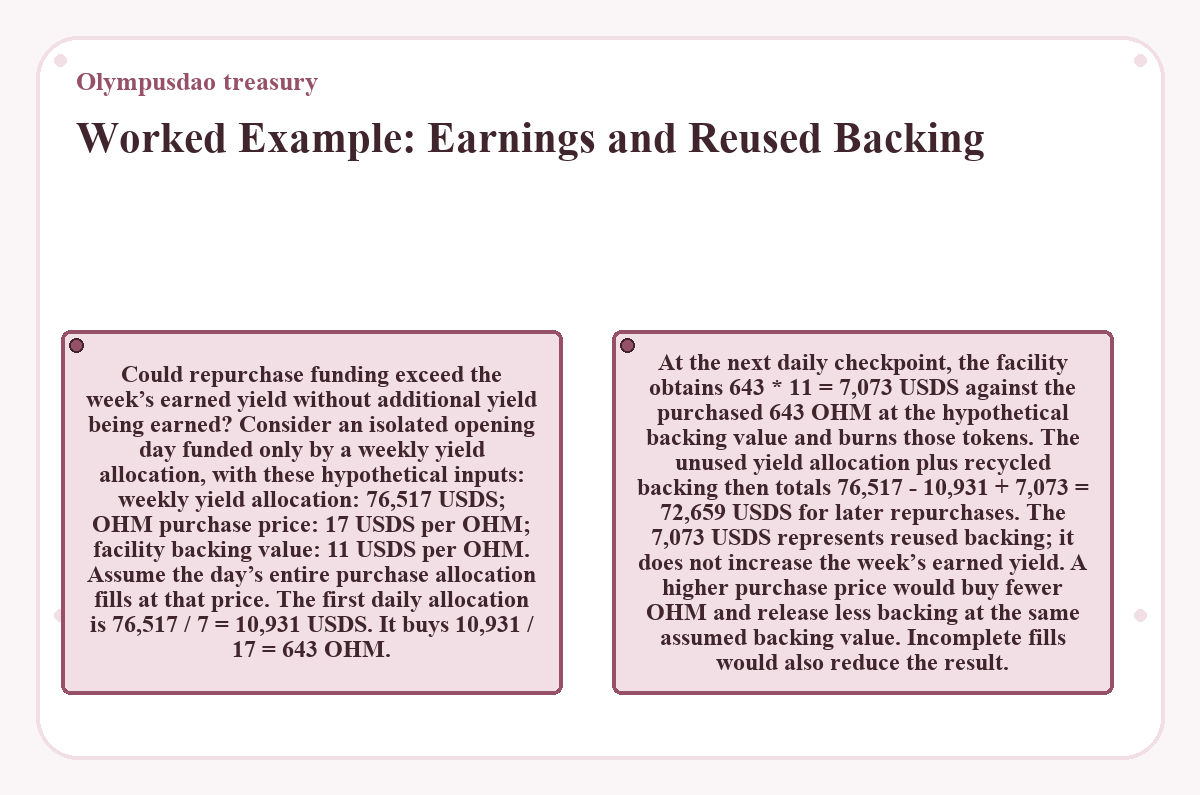
Could repurchase funding exceed the week’s earned yield without additional yield being earned? Consider an isolated opening day funded only by a weekly yield allocation, with these hypothetical inputs: weekly yield allocation: 76,517 USDS; OHM purchase price: 17 USDS per OHM; facility backing value: 11 USDS per OHM. Assume the day’s entire purchase allocation fills at that price.
The first daily allocation is
76,517 / 7 = 10,931
USDS. It buys
10,931 / 17 = 643
OHM. At the next daily checkpoint, the facility obtains
643 * 11 = 7,073
USDS against the purchased 643 OHM at the hypothetical backing value and burns those tokens.
The unused yield allocation plus recycled backing then totals
76,517 - 10,931 + 7,073 = 72,659
USDS for later repurchases. The 7,073 USDS represents reused backing; it does not increase the week’s earned yield. A higher purchase price would buy fewer OHM and release less backing at the same assumed backing value. Incomplete fills would also reduce the result.
Reserve Inflows and Depositor Principal
The Emissions Manager sets issuance offers using OHM’s premium relative to backing and governance-controlled parameters. Its Convertible Deposit auction operates when the premium exceeds the configured minimum and is disabled when that condition is not met. An undersold tracking period can lead to a Bond Protocol fallback market, whose usable capacity depends on configuration. Offered capacity is distinct from reserves received or OHM already minted.
Convertible Deposits initially place user assets in the DepositManager, separately from the protocol treasury. Conversion consumes receipt tokens, transfers the corresponding deposit assets to the treasury and mints OHM. An early reclaim returns the portion set for that asset and deposit period; the reclaim discount goes to the treasury.
Deposited assets can generate protocol income while the principal remains held for users. An unconverted deposit balance therefore cannot automatically be counted as unrestricted treasury-owned reserves. Conversion also increases OHM supply, so its reserve inflow needs to be assessed alongside the associated issuance.
Governance and Policy Status
The Olympus V3 Treasury Module (TRSRY) manages deposits, withdrawals and debt allocated to policies. Permissioned functions require authorized policy contracts. Governance can change backing composition and policy parameters, while Olympus’ governance documentation describes a transition involving Governor Bravo and multisigs. A description of contract permissions does not by itself identify every live role holder.
Range Bound Stability (RBS) is disabled. Its buying and selling functions have been replaced by YRF and the Emissions Manager. Historical OHM/DAI wall prices and RBS capacity rules describe that inactive design; they do not establish an additional live redemption facility or a guaranteed OHM price floor.